
Feed on
Posts
Comments

Dr. Reichard describing the extent of White-nosed Syndrome in bat populations in the northeast US.

Dr. Jonathon Reichard, Assistant National Coordinator for White-nosed Syndrome at the US Fish and Wildlife Service, gave a fascinating talk about the state of bat populations in our region. It’s really quite scary to know that some species of bats have decline by 95% since 2007. After starting in New York state, it’s spread down the Appalachian mountain chain and into several Canadian Provinces, each year claiming more bat victims.

White-nosed Syndrome was first noticed in 2007, and traced back using photo records to Howes Cavern in 2006.  Scientists still know very little about how it got there, how to treat infected bats, why the bats die or how it is spread.  They have identified a fungus, Geomyces destructans, that seems to be linked to the disease, which is a soil-based fungus. Interestingly, the fungus is found in many places around the world without being associated with white-nosed syndrome and causing massive bat mortality. We don’t know why bats are dying. One hypothesis is that bats must fight the infection, using precious energy when they should be hibernating, and starving before warmer spring weather arrives.

EQLT members sitting down to enjoy a bountiful potluck supper

There are seven species confirmed to have white-nosed syndrome, all of which are hibernating species. Not all species are impacted as severely as the little brown bat. However it appears that in addition to outright mortality, the reproductive rates are also declining. There maybe other factors that stress bats and threaten their survival.

There aren’t any known hibernaculum in our area of Massachusetts, so we can help by encouraging summer roosting sites. We have several different bat species using the Frohloff barn and discussed the possibility of adding a special bat house structure in the barn this summer. Stay tuned.


The 2013 Envirothon team from the Quabbin Regional High School

The Quabbin Regional High School Envirothon Team of 2013 recently spent time getting to know the forest communities and wildlife habitats of the East Quabbin Land Trust’s Frohloff Farm in Ware. The students are dedicated to learning about forests and addressing environmental issues within our community. This year’s Mass Envirothon focus is “Trees, Forests, and Sustainability” and envirothon teams around the state are identifying ways that trees and forests can contribute to a sustainable future, and what steps we may take to ensure that trees and forests are conserved over the long run.

The forests at Frohloff Farm are managed by the East Quabbin Land Trust under the guidance of a professional licensed forester for wood products, wildlife habitat, and protection of more than a half mile of forest and marsh along the Ware River. The long term and continued viability of these forests helps protect public drinking water, sensitive terrestrial and aquatic resources, the scenic character of the farm, and recreation opportunities along the rail trail and river corridor. The forests serve as the backbone of a riparian corridor helping to conserve and connect wild species and their habitats. The forests become a refuge for many wildlife species and provide a corridor for movement, allowing species to shift ranges and adapt to changing climate and other environmental conditions over time.

A timber harvest to improve wildlife habitat and restore a declining forest is scheduled for later this year. A unique Pitch Pine and Oak Woodland occurs along the river bluff on sandy outwash soils.  According to the Massachusetts Natural Heritage and Endangered Species Program, this forest was once more widespread along rivers in central Massachusetts but is now declining due to habitat elimination and lack of periodic disturbance such as fire.

Marshal girdles a white pine to create a snag for wildlife feeding and nesting

The timber harvest will remove overstory White Pine as well as several other tree species and this work will take place under the direction of Massachusetts Forest Stewardship and Forest Cutting Plans approved by the Mass Department of Conservation and Recreation. The logging will be followed by invasive plant control and prescribed burning to encourage seed germination and growth of Pitch Pine and Oak trees. This woodland provides important habitat for Brown Thrasher, Eastern Towhee, and American Woodcock. Creation of small sandy openings within the woodland will provide potential habitat for Whip-poor-wills and important nesting habitat for the rare Wood Turtle, which spends much of its time within the forests adjacent to the Ware River. The logging will occur in the late fall and winter months when Wood Turtles are not in the upland forests but resting under water in the Ware River. The project is supported in part by a grant from the USDA Natural Resources Conservation Service.

Measuring the Success of Forestry Practices

The Envirothon Team – armed with clipboards, cameras, flagging, metal tags, and measuring tapes – inventoried trees and tagged the Pitch Pines that will be reserved, or left in place, during the timber harvest. They took notes on the size and health of individual trees, so that we can follow the trees over time. This baseline monitoring and future sampling will help us determine whether the Pitch Pines respond favorably to logging of over-story White Pine, the removal of the invasive shrub, Glossy Buckthorn, and prescribed burning.

Creating Snags for Wildlife

The Team surveyed the proposed logging area in search of wildlife snags. Several dying or dead standing trees such as Black Cherry, White Ash, and White Oak were noted as good wildlife habitat and flagged as trees to reserve from logging.  The students weathered the black flies and ticks on this sunny spring day to find two very tall and large diameter white pines that will serve as wildlife snags. Yielding hatchets and bow saws, they cut into the cambium layer of each tree’s trunk and girdled the trees to create snags.  By cutting the cambium layer, the pine will remain standing and die slowly over the next year or two.  Although the trees will eventually die, they will bring new life to the forest for many years to come in the form of increased food supplies for birds such as pileated woodpeckers and good nesting, roosting, and shelter for wildlife.

Maintaining Openings to Enhance Wildlife

Envirothon students clearing out grey birch to improve plant diversity and wildlife habitat along the Ware River at the Frohloff Farm

The energy and enthusiasm of the Envirothon Team was boundless.  The students volunteered to cut sapling White Pine, Grey Birch, and Glossy Buckthorn shrubs that were invading small openings within the woodland. The sunny and sandy openings are potential Wood Turtle and Whip-poor-will nesting and resting sites. These areas also serve as important sites for Pitch Pine seed germination and establishment.  Pitch pines are shaded out by the faster growing and more densely packed trees and shrubs. The students helped cut and pile many shrubs and saplings too small for the logging equipment to tackle during the upcoming timber harvest. Their work will make a big difference in keeping these areas open.

Many thanks to the Quabbin Regional High School Envirothon Team and their advisor, Becky Bottomley, for their dedication and stewardship contributions toward sustaining the forests of Frohloff Farm.    

Briefly-blooming beauties

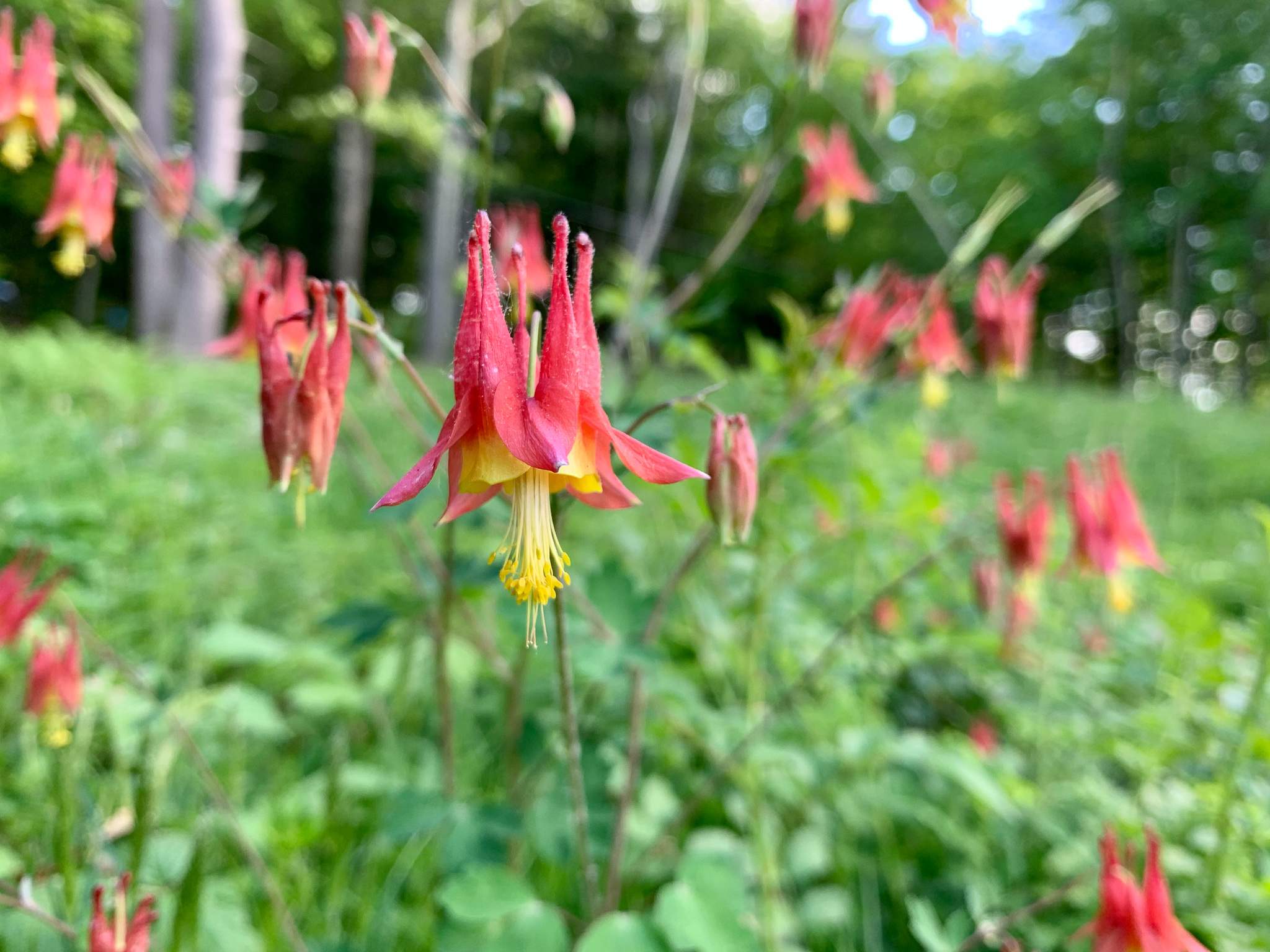
On April 28th we explored the fields, woods and marshy areas along Muddy Brook and discovered some early season spring ephemeral plants. Here’s a few images for you to enjoy (Thanks Ann!).  Other flowers and plants observed during the walk included: Golden Alexander, wood anenome, marsh marigold, lupine, dwarf ginsing, wild geranium, meadow roe, star flower, sessile-leaved bellwort, wintergreen, partridge berry, spice bush, tooth wort, shinleaf pyrola, Solomon seal, nodding trillium, gooseberry, red-elderberry, Jack-in-the-pulpit, trumpet honeysuckle and rattlesnake plantain.

Bloodroot in bloom. Plants closer to Muddy Brook were already gone by, but these were up on the talus slope of the Hyde Woodland Preserve.

These spring beauties were enjoying the sunshine on the southwestern slope with sandy soil.


The trillium flower bud is visible in the center of the leaves, almost ready to bloom.

Peent Peent Peent


The peent peent peent of the American woodcock was heard all around the brushy fields at the Frohloff Farm and the Ware River corridor last night. We debated about whether or not it was too windy for the birds to be thinking about mating. The woodcock didn’t seem to mind, and the rain held off.

Out at dusk, the group looking for the flight of the woodcock included Chris, Jeff, Caren, Linda and Rod


A small group meandered down to the Ware River as we waited for dusk to come. The call of several male woodcock was clearly heard on the other side of the river among the shruby embankment. As we stood listening two Canada geese came in for a landing and little brown bats were out foraging for the evening. Heading back to the barn we stopped along the trail and listened to other woodcocks calling to find mates. The breeze was warm and the woodcocks stopped calling while there was still enough light to get back to our cars without flashlights. A beautiful evening all around.

Harry clearing an oak top that landed in the middle of the trail

The first of many steps in opening the Mass Central Rail Trail from the former New Braintree Train Station to Wheelwright was accomplished on Saturday, April 6th.  Thanks to a dedicated crew that deployed four chain saws and many hands to throw the brush and trees off the trail. This section of trail hasn’t been cleared in many years, maybe since the trains stopped in the 1970′s. Recent ice and snow storms significantly added to the number of trees down or damaged along this stretch.

By clearing off the debris, the railroad ties can be removed opening up access to begin bridge repairs. This trail section will remain closed until all repairs are completed, with an anticipated completion date of late summer 2014.

Part of the rail trail crew that helped clear debris from the trail. Thanks to Harry, Mark, Renee, Gary, Jeff, and Denis. Other helpers included Janice, Denise, Erin and Cynthia.

Eagle Hill School student taking a photograph of the wintery landscape from EQLT offices looking over the Ware River valley

The Photography class at Eagle Hill School has been spending a lot of time out on some of EQLT’s most beautiful properties.  Pat Bock, Eagle Hill’s Photography teacher, and Kelly Wheeler, EQLT’s Americorps Service Learning Coordinator have been bringing the students to a different property each week to hold a photo shoot.  The students are learning to take black and white photographs of natural objects and landscapes.  While out on the properties the students are encouraged to explore and photograph whatever speaks to them.  All the while, Pat shares with them tips on how to frame a shot for the greatest impact and how to use natural lines to draw the eye to a particular focal point.  Kelly points out animal tracks, plant species, and wildlife sign.  On Patrill Hollow alone, there were raccoon, ruffled grouse, rabbit and fox tracks as well as some beautiful woodpecker galleries.  In the course of this project the students will have visited Mandell Hill, Patrill Hollow, Coxhall Kitchen Garden, and the Mass Central Rail Trail.  After the photo shoot each week, the students spend time in the dark room developing their pictures.  At the end of the school year the photos will be displayed at the annual Arts on the Hill that takes place in Eagle Hills Cultural Center for the parents, students, and faculty.  A separate showing will occur for the public at EQLT’s offices on June 21st.

Volunteers that helped create the Bluebird trail at Mandell Hill

Twenty enthusiastic volunteers gathered at East Quabbin Land Trust’s Mandell Hill Preserve in Hardwick on Sunday March 24 to usher in spring and install Bluebird nest boxes along the walking trails and stone walls of this scenic working farm. Harrison Achilles, a local birder and craftsman, started the afternoon off with an informative presentation on how to construct the ideal Bluebird house and gave tips on how to install the boxes and monitor nesting success.


Attaching perches to the top of a Bluebird nest box

The group soon got to work preparing nest boxes, clearing brush, and installing boxes in strategic locations. And it was just in time, as we saw several male and female Bluebirds flitting around fence posts and the bird observation tower that day. Thanks to the following dedicated volunteers, we now have over 25 nest boxes set up at Mandell Hill. We thank Debra Jerome, Ron and Barb Newton, Sheila Croteau, Erin Mascroft and her children, Rod and Linda Leehy, Tom Clark, Doris Matthews, Barbara Hanno and her young friend Karynn, Jane and John Freeman, Charlie Burnham, Mark Mattson, Jeff Smith, Caren Caljouw, and Harrison Achilles.  And a special thanks to Country Bank for supplying several enthusiastic volunteers that day. Now that spring is finally here, bluebirds, tree swallows, kestrels, and bobolinks will soon be calling and flying about Mandell Hill, so please visit the trails and observation tower soon!

Bald Eagles Spotted

Members of the group using the spotting scope and binoculars to watch the nesting pair of bald eagles

On Saturday, February 23rd, the East Quabbin Land Trust hosted an Eagle Walk into Quabbin Gate 35.  This has become a semi-regular February event beginning in 2005.  Conditions this year were prefect – gray sky, no wind and 28° – and the eagles were cooperative.  One pair was seen the entire time perching in and around their nest and interacting with each other.  A third eagle (an immature) was also well seen by everyone, and a raven was heard and made a brief appearance.  Though, very few other birds were seen, the spectacular scenery of the frozen reservoir framed by snow covered ridges, along with the deep quiet of this valley as a snow storm approached, made for another memorable trip.

Ice along the shore of the Quabbin Reservoir

Full Day of Fun

Burning brush near the Frohloff house. Many thanks to John, Paul, Darrell, Elisabeth, Martin, Denis, Janice, Caren, Kristen and Jerry for their assistance.


Last Saturday was a beautiful day! Many visitors and volunteers came out to the Frohloff Farm to enjoy the sunshine and explore the property. Groups split up and tackled the brush burning in front of the farmhouse, along the road and behind the barn. Many piles were successfully burned!


The rest of the day included:

  • a large group walking with Caren, EQLT’s Stewardship Coordinator, and Roger, a consulting forester, to discuss the proposed wildlife habitat improvements;


  • many visitors walking through the farmhouse, noticing special features of the wainscoting, wallpaper and setting;


  • After roasting hot dogs and marshmallows, several youngsters enjoyed burning their roasting sticks

    the bonfire was enjoyed by a small, but enthusiastic group, that also walked down to the Ware River and watched ice chunks flow down stream. It was a beautiful night to be outside, and a wonderful way to wrap up a full day of fun at the Frohloff Farm.

Looking at the Frohloff house Sunday afternoon as volunteers cleaned out all the remaining items prior to the start of renovations

The East Quabbin Land Trust is extremely pleased to announce the recent purchase of the Frohloff farmhouse at 236 Church Street in Ware.  “With this acquisition, we are putting the farm back together into a viable unit that can sustain a vibrant agricultural enterprise,” stated Jerry Reilly, EQLT Board Member.

Land trusts play a critical role in promoting meaningful agriculture within our service communities.  Protecting and providing viable farmland are critical pieces that land trusts are uniquely set up to do.  Sometimes more is needed.

Providing housing is a vital component to any successful farming venture at the Frohloff Farm.  Being close to livestock and produce is essential for successful farming, for instance, to ensure that watering and feeding can happen in the midst of winter storms; to allow for quick retrieval of escaped animals, or regularly engaging with visitors to the farm.  Integrating housing into the farming unit expands the diversity of potential farmers and saves their precious initial capital for building a sustainable viable farm business.  Although historic preservation may not often be associated with land trust activities, the preservation of historic landscapes and the relation of the built environment to the natural environment can be an important community signpost that a well-known and perhaps well-loved property is again being cared for.

Denis and Mark carrying out bureau drawers that will be saved for future use at the farm.

The East Quabbin Land Trust has identified a group of farmers interested in undertaking the rejuvenation of the Frohloff Farm. Starting this spring we will be leasing the farm to them with the expectation that farming practices will be in the form of a diversified family farm with crops, value added products (such as cheese and canned goods), and a traditional barnyard mix of income producing livestock.  As low-income farmers with limited capital resources, they have presented a strong, staged-growth proposal that includes a balanced mix of meat, egg, orchard and crop production enterprises that are thoughtfully tailored to build the carrying capacity of the land.

The farmers are led by an experienced farmer and agrarian consultant whose 25-year Cornell University background includes an undergraduate degree in International Agriculture, professional work in Community and Economic Development, and graduate work in Adult and Extension Education.  The remainder of the group is made up of second and third year beginning farmers.  Together, these farmers are passionate about community supported agriculture, holistic land management practices, and sustainable organic farming.  We feel that they have the knowledge, passion, business and management skills needed to enable Frohloff Farm to succeed in its mission.

Starting soon you will see more changes at the Frohloff farmhouse as contractors begin the renovation process.  The farmhouse has good bones, but lacks most features for modern living, including central heating, septic system, insulation and air tight windows and doors.  A new kitchen will be installed suitable for teaching sustainable, healthy food preparation.  New bathrooms will meet current building codes.  In addition, upgrades to the electrical and plumbing at the barn are essential for expanded use.

On Saturday February 2nd we are hosting our annual workday and bonfire at the Frohloff Farm.  From 3:30 pm until dark the Frohloff house will be open for visitors to view the house.  The bonfire with hotdogs and s’mores will start at dark.  We hope to see you there.

Older Posts »